


Oaks are the most magnificent and beneficial trees in North America. Both of our properties have several huge oak residents who provide an incredible ecosystem for literally hundreds of life forms! Did you know the white oak is the state tree of Maryland? If you have never taken time to really marvel at these stoic beauties, continue to read and see why these trees are truly mighty.

Professor Doug Tallamy, from the University of Delaware, is a renowned entomologist and tireless advocate for restoring the natural environment starting in our very own backyards. I had the pleasure of attending, in person, one of Professor Tallamy’s talks and his message was very compelling. Backed by his own research and science, he states that we are losing so many native birds and essential insects because we are losing our native plants. This is due to the presence of invasive plants, as well as people’s desire to have well manicured lawns which require the removal of trees and native plants that do not appear as attractive in landscaping.
I became introduced to the concept of an invasive plant during my studies to become a Master Gardener under the University of Maryland Extension. I assumed plants popping up in natural areas were all good. Plants are plants and plants are good, right? Well, I was surprised to find out that many of the natural areas, as well as people’s backyards, contain invasive plants that are actually harming the ecosystem. Man brought in ornamental plants from other parts of the world to make their yards look more attractive and these plants have spread and propagated and are taking out our native plants. They consume resources to make our native plants compete. Native plants support an ecosystem of birds and bugs and other creatures who depend on that native plant to survive. With the loss of native plants, we also lose many insects which are the food source for many birds and other animals.
In his book The Nature of Oaks: The Rich Ecology of our Most Essential Native Trees, Doug Tallamy makes a case for native plants, specifically oaks, through the documentation of a ten year period at his property located in Pennsylvania.
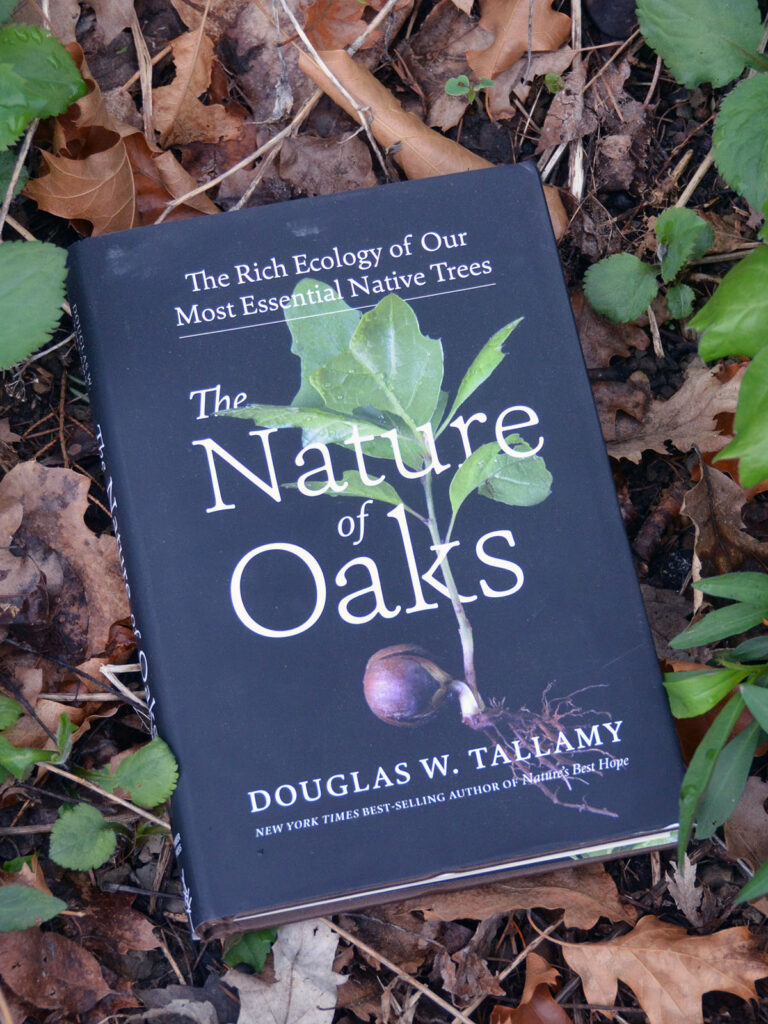
He states: “Most song birds in North America are primarily insectivores and use seeds and berries to supplement their diet. Birds in the nest are unable to digest seeds so most bird species cannot reproduce without a good supply of insects. When we reduce the number of native plants, we reduce the diversity and abundance of insects. There are now 3 billion fewer birds in North America than there were just 50 years ago, and over 430 birds species in North America are declining so rapidly that they are now considered at risk of extinction.” (Tallamy,34)
“About 75% of the insect food required by birds and other animals is produced by just a few plant genera. These are known as keystone plants and in North America include oaks, cherries, willows, birches, hickories, pines and maples. The oak hosts 511 species of moths and butterflies which is 100 more species than its closest competitor, the native cherry. Oaks are the top life support trees in 84% of the counties in North America. A yard without an oak is a yard with only a fraction of its life support potential.” – Doug Tallamy
Unfortunately, most homeowners don’t like oak trees because they make such a mess! Hundreds and hundreds of acorns fall each autumn making the ground a bit treacherous below the tree and those darn oak leaves! They stay on the tree forever and when they do fall, they do not decompose very fast. Clean yard fanatics want all this mess cleaned up causing them to bring out leaf blowers and choppers to do all they can to eradicate this eye sore. Sadly, by doing this, many insect larvae that nest in the leaves are lost and will not be able to be used to support the birds who will be looking for them to eat. It’s a full circle of life and nature does what it does for a reason. When humans decide this is untidy and needs to be cleaned up, the impact extends way beyond a clean looking yard. One of the benefits of oaks, which nature designed, is that their leaves stay on the tree through much of the winter. This enables rain to get caught on the leaves and filter down to the base where many acorns are sitting. The leaves that do fall do not decompose as quickly as other leaves, which creates a nice growing environment for baby oaks as they provide a natural mulch. So, as you can see, all these “annoying” traits of the oak, are actually essential for maintaining the diverse ecosystem in your yard.
On both our properties we have the Northern Red Oak (Quercus rubra) and the White Oak (Quercus alba). It’s been amazing to observe these two species and note the differences. In our area, the white oaks drop many more acorns than the red oaks and these acorns are ready go to! They can be sitting on the ground for less than a day and begin sprouting a root immediately! They so want to get going and implant themselves in the soil. White oaks will create a root system immediately before the dead of winter as they begin growing their big taproot. They continue to grow underground for much of their first year putting all their energy there. They appear to not be doing much above ground but that is because they are working on developing a strong foundation.
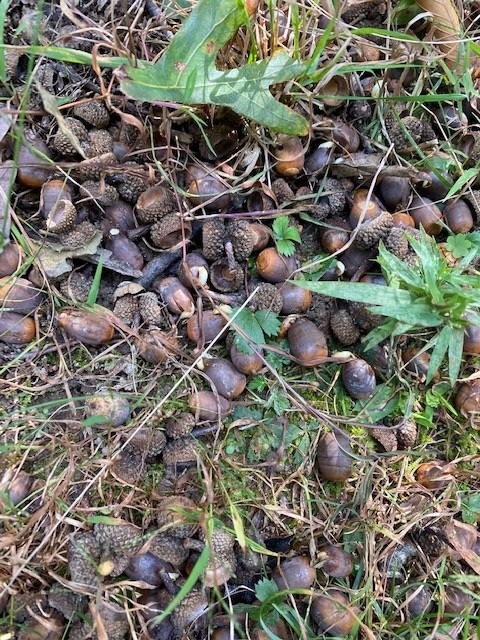
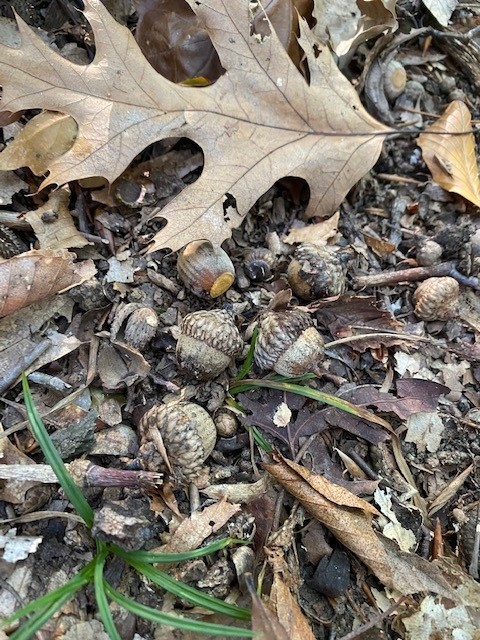
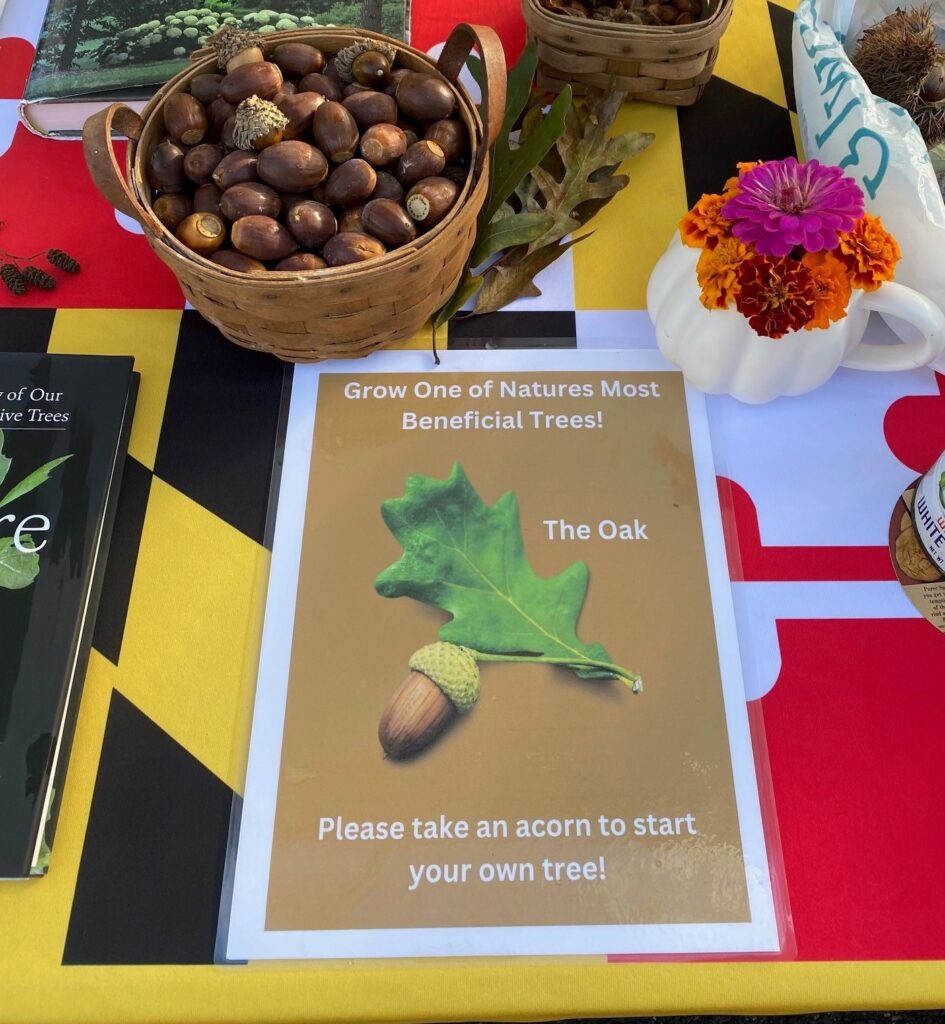
The acorns from red oaks on the other hand are not as ambitious and are content to wait before they decide to start growing. I have observed this right on our own property as the acorns of the whites will start sprouting roots immediately. I collected many acorns to display and distribute at the local farmer’s market where I volunteer as a Master Gardener ambassador and the acorns I had sitting in a basket will start to sprout! My goal at the market was to encourage as many people as I could to take a few acorns and plant them in a pot or a raised bed in the fall to get some seedlings started. My hope is then that they could be planted in the ground next spring and protected from wildlife with a cage like fence. If just a few of these trees could make it, we could add to the local ecosystem.

This fall has been our first one at the farm property and there is a huge white oak just outside the barn door. This oak dropped so many acorns that I filled three 5 gallon buckets in less than an hour in just a few square feet at the base of this tree. Oaks are interesting in that some years they drop a huge load of acorns and other years it’s less. The prolific years are known as mast years and scientists are still developing theories on why this occurs. All these buckets of white oak acorns wanted to be trees so badly that they were sprouting in the buckets! I gave away as many as I could and relocated many to better suited areas at the farm. I also hand planted many in pots and beds to allow them to get a root system going. My long-term goal is to populate sections at the front of the farm property with oaks in a small grove. I will never get to see what they will become in a few hundred years, but I will know I did my part to keep the ecosystem at the farm intact the best way I can.
I have always been in awe of these mighty trees, and I hope this information shared has been interesting. I hope you can appreciate the oak as a keystone plant that is supporting a big population of very important creatures who are all needed to keep a diverse ecosystem. Oaks are amazing in both their stature and importance. If you’d like to try to grow an oak, please reach out to me and I will share some acorns. Now go hug an oak tree because they are awesome!


0 Comments